
Every product team faces the same challenge: infinite demand, finite capacity. Stakeholders believe their requests are urgent, sales wants features that close deals, engineering wants to fix technical debt, and leadership wants strategic initiatives. Everyone has a compelling case for why their work matters most.
The natural response is to rely on gut feel or defer to the highest-paid person’s opinion (HiPPO). This works fine when your backlog has a few items, but breaks down completely for complex work. Without a systematic approach, you end up with half-finished products, reactive firefighting, and work that seemed important three months ago but no one remembers why.
Prioritization frameworks exist to make tradeoffs visible and defensible. They force you to articulate why one thing matters more than another. They create a shared language for discussions about priority. The goal isn’t perfect predictions about value or effort. The goal is moving from implicit assumptions to explicit reasoning that you can test and improve.
This guide covers four product prioritization techniques you can implement immediately. These frameworks require minimal setup, work in spreadsheets or on whiteboards, and don’t demand financial projections or advanced analytics. Master these fundamentals before moving to more sophisticated prioritization methods like RICE, WSJF, or Cost of Delay. We will cover these more advanced techniques in a future post.
MoSCoW Prioritization Method
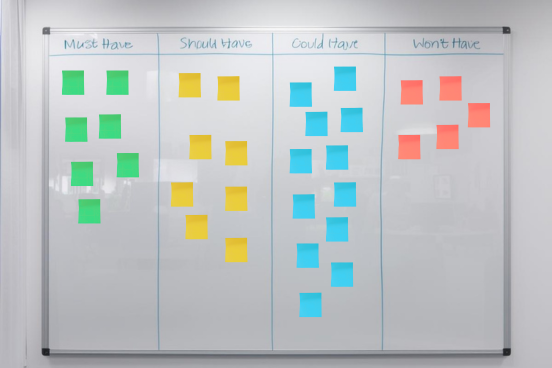
The MoSCoW method sorts work into four categories: Must have, Should have, Could have, and Won’t have. It’s a binary sorting exercise, typically done with stakeholders in a workshop setting.
Must haves are non-negotiable for the release or time period you’re planning. These are the minimum features or requirements without which you cannot launch. Should haves are important but not critical. The release would work without them, but users would notice their absence. Could haves are nice-to-have improvements that add value but aren’t essential. Won’t haves are explicitly out of scope for this release, which prevents them from creeping back in through side conversations.
The technique works well because it uses plain language that non-technical stakeholders understand immediately. There’s no need to explain scoring systems or mathematical models. It builds consensus quickly by forcing teams to agree on what’s actually essential versus what’s merely desirable.
How to Use MoSCoW Prioritization
The workshop format is straightforward. Start by defining the constraint. Are you planning a release, a quarter, a phase? Make it concrete. Then begin with the Won’t have category. This sets boundaries and takes pressure off the remaining categories. If something is explicitly out of scope, you don’t need to argue about its priority. Move through Could haves and Should haves, then tackle Must haves last.
The critical discipline with MoSCoW is defending the definition of Must have. Musts naturally get inflated because stakeholders believe everything they want is essential. The test is simple: Can you launch without this? If the answer is yes, even if you’d prefer not to, it’s not a Must have. Reserve this category for genuine blockers and core functionality.
Limitations and When to Use MoSCoW
The weakness of MoSCoW is that it doesn’t create relative priority within categories. You might have 20 Must haves, but you still need to decide which to build first. It also ignores cost and risk entirely. A Must have that takes six months gets the same categorization as one that takes two days.
Use MoSCoW for initial release planning, scope negotiations with stakeholders, or situations where you need to align a diverse group quickly around what’s in scope and what’s not. It excels at creating shared understanding about boundaries, less so at determining sequence within those boundaries.
Force Ranking Prioritization Technique

Force ranking creates an ordered list where every item has a unique position. No ties, no equal priorities. Item one is more important than item two, which is more important than item three, all the way down the list.
The technique forces actual priority decisions. In most backlogs, half the items are marked high priority or Must have, which makes the designation meaningless. Force ranking eliminates this problem by requiring you to choose: If you can only do one more thing, what is it? Then ask again for the remaining items.
How to Use Force Ranking
Start with extremes to make the process faster. Identify your top items and bottom items. These are usually obvious. Then fill in the middle by comparing remaining items pairwise or in small groups. The key question is always: If I could only do one of these, which would it be?
Force ranking works particularly well when you are working with say 10 to 30 items and need a clear execution sequence. It’s also effective for small feature sets where scope is fixed but order matters. Teams appreciate the clarity it provides. There’s no ambiguity about what to work on next.
Limitations and When to Use Force Ranking
The technique breaks down at scale. Ranking 100 items is time-consuming and creates artificial precision. The difference between item 47 and item 48 is often negligible, yet force ranking demands you choose. It also doesn’t capture magnitude. The gap between your first and second priority might be enormous, or they might be nearly equivalent. The ranking shows sequence but not relative importance.
Use force ranking when you need a clear execution order for a manageable set of items. It’s ideal for roadmap sequencing for a small product area, or any situation where you have limited capacity and need to make explicit choices about what happens first versus second versus third. It’s great to use on the Must haves from MoSCoW.
Impact Effort Matrix: A Visual Prioritization Tool
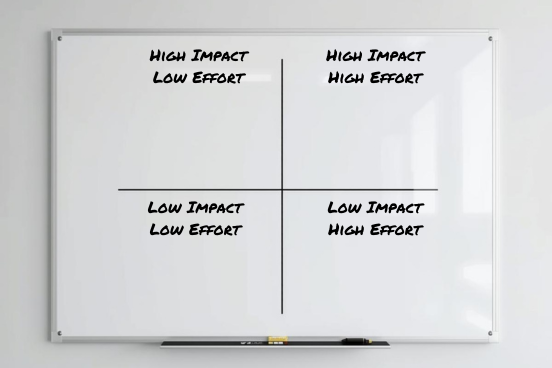
The Impact/Effort Matrix plots work on a 2×2 grid with Impact on one axis and Effort on the other. Impact represents value, whether that’s user benefit, revenue, cost savings, or strategic importance. Effort represents cost, complexity, or time required. Some teams call this matrix Value/Cost, especially when communicating with business stakeholders.
The four quadrants have memorable names that help teams remember and use them. Quick Wins are high-impact, low-effort. Do these first. They deliver value fast without consuming significant capacity. Major work is high-impact, high-effort. These are substantial initiatives that require careful planning and resource allocation. Fill-Ins are low-impact, low effort. These are minor improvements you can tackle when capacity allows, but shouldn’t prioritize heavily. Time Wasters are low-impact, high effort. Challenge why these exist in your backlog at all.
How to Use the Impact Effort Matrix
The matrix works because it’s highly visual and intuitive. To use the matrix effectively, plot items as a team. Don’t obsess over exact placement. The goal is categorization, not precision. If an item falls near a boundary, discuss why different people see it differently. That conversation often reveals important information about risks, dependencies, or assumptions.
Limitations and When to Use the Impact Effort Matrix
Impact and effort assessments rely on subjective judgment. Without clear criteria, teams place items based on opinion rather than evidence. The matrix also doesn’t account for risk, dependencies, or timing constraints. A high-impact item might carry delivery risk that changes its attractiveness, or strategic value that’s difficult to quantify as simple “impact.”
The most common mistake is optimism bias. Everything clusters in Quick Wins because teams overestimate impact and underestimate effort. Combat this by forcing honest assessment during plotting sessions. If one quadrant is overcrowded, you’re not differentiating enough. Another mistake is tolerating Time Wasters. Remove low-impact, high-effort items from the backlog entirely rather than letting them consume mental overhead.
Use the Impact/Effort Matrix for initial backlog refinement, quarterly planning sessions where you need to filter a large set of candidates, or portfolio reviews where you’re evaluating multiple initiatives. It’s particularly valuable when you need to get a team unstuck and moving forward. After plotting items, force rank within the Quick Wins quadrant to determine the actual sequence.
Value Risk Analysis for Risk Prioritization
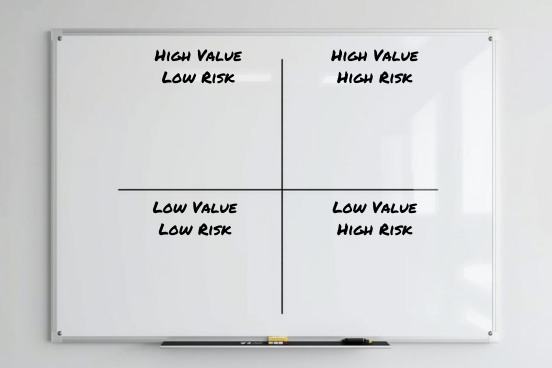
Value/Risk analysis plots value against implementation risk, market risk, or both. Instead of comparing value to cost, you’re comparing value to uncertainty. The goal is identifying high-value opportunities with manageable risk.
The technique works similarly to the Impact/Effort Matrix but swaps effort for risk on the second axis. High-value, high-risk items are your big swings. These need careful evaluation and often benefit from risk reduction activities before full commitment. Do these first. This is the fail fast/fail early consideration. If something is important, we want to de-risk it early on. High-value, low-risk items are your best bets. Do these second. Low-value, low-risk items are safe but underwhelming. Do these only if you have excess capacity. Low-value, high-risk items should rarely, if ever, be pursued.
How to Use Value Risk Analysis
Value/Risk is particularly useful in environments with significant uncertainty. New product development, entering new markets, evaluating emerging technologies, or making architectural decisions all involve substantial risk. In these contexts, risk deserves explicit consideration rather than being buried in effort estimates.
The analysis forces explicit discussion about what could go wrong. Teams often focus on optimistic scenarios where everything works as planned. Risk-focused prioritization counteracts this by requiring people to articulate specific concerns. What’s the implementation risk? Do we have the skills, technology, and capacity? What’s the market risk? Will customers actually want this? Will competitors respond? What’s the integration risk? How does this interact with existing systems?
Limitations and When to Use Value Risk Analysis
Risk assessment is inherently subjective. Different people have different risk tolerances and mental models. What one person sees as low risk, another sees as substantial. This creates productive discussion when used well, but can stall decisions when disagreements can’t be resolved. The approach also ignores cost entirely. High-value, low-risk opportunities might still be prohibitively expensive.
Value/Risk excels when you’re building innovation portfolios that balance safe bets against bold experiments. A balanced portfolio includes work in multiple quadrants. Pure optimization would suggest doing only high-value, low-risk work. In reality, you need some big swings to drive significant improvements, even if they’re risky. Value/Risk helps you have informed conversations about portfolio balance rather than accidentally ending up with too many high-risk products/features, or too few ambitious ones.
Use this framework when entering uncertain markets, making technology choices with significant implications, or when your organization has become too risk-averse and needs to see potential upside alongside the risk.
Choosing the Right Prioritization Framework
Most teams benefit from using different frameworks for different situations rather than committing to a single method.
| Framework | Best For | Key Strength | Main Limitation |
|---|---|---|---|
| MoSCoW | Release planning, scope definition with stakeholders | Plain language everyone understands; explicit scope boundaries | No relative priority within categories; ignores cost and risk |
| Force Ranking | Small feature sets (10-40 items) | Clear execution sequence; eliminates ambiguity | Breaks down at scale; doesn’t show magnitude of difference |
| Impact/Effort Matrix | Backlog grooming, quarterly planning, portfolio reviews | Visual and intuitive; generates productive discussion | Subjective assessments; prone to optimism bias |
| Value/Risk Analysis | Innovation portfolios, uncertain markets, new technologies | Makes uncertainty explicit; balances portfolio risk | Risk assessment is subjective; doesn’t account for cost |
For fast stakeholder alignment, the Impact/Effort Matrix offers the quickest path forward. Its visual, intuitive nature generates productive discussion, and you can run a workshop in an hour and walk out with a categorized backlog.
Release planning with mixed stakeholder groups works best with MoSCoW. The plain-language categories make sense to everyone, and the Won’t have category provides explicit scope boundaries. You can follow that up with Force Rank for the Must haves. For decisions where risk and uncertainty dominate, Value/Risk makes those tradeoffs explicit rather than implicit.
When Simple Frameworks Aren’t Enough
For most day-to-day prioritization work, these five simple techniques handle the majority of situations effectively. More advanced methods like RICE scoring, Weighted Shortest Job First, and Cost of Delay have their place for investment decisions and flow optimization. If you are making large investment decisions, then you’ll need financial rigor and methods like ROI, IRR, and NPV. These advanced techniques will be covered in a future post.
Remember that the real value of any prioritization framework isn’t the scores it generates. It’s the conversation it enables. A team that discusses impact, effort, value, cost, and risk explicitly will make better decisions than a team using sophisticated mathematics without critical thinking. The framework is a tool for structured reasoning, not a replacement for judgment.
Ready to take prioritization further or develop complementary product management skills? These workshops provide hands-on practice with the frameworks covered in this post
Building Innovative Products Workshop – Apply prioritization frameworks within the full product development cycle. Learn systematic approaches to product discovery, validation, and roadmapping that help you prioritize the right work before you build it.
Prioritization Workshop – focuses specifically on applying ICE, RICE, weighted scoring and other techniques useful for your organization.