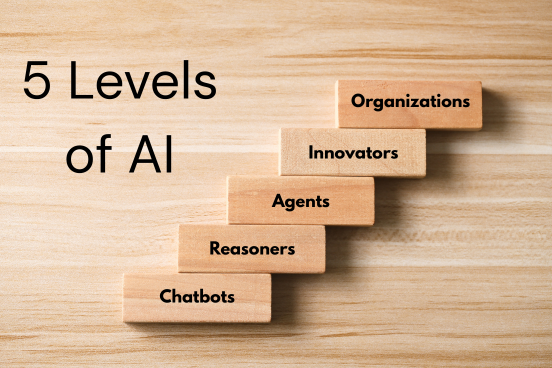
OpenAI has mapped out five levels of AI capability on the path to Artificial General Intelligence, or AGI. It has become a useful way to understand where AI is today, what comes next, and how far the progression extends.
The five levels are: Chatbots, Reasoners, Agents, Innovators, and Organizations. Each represents a meaningful increase in what AI can do, with the higher levels progressively reducing the need for human direction.
Chatbots and Reasoners: Where the Field Stands
Chatbots
Chatbots, Level 1, is where most AI systems used today operate. These are systems capable of conversational language, understanding input and generating relevant responses. ChatGPT, Gemini, and similar tools fall here. The system responds to what the user brings to it.
Reasoners
Reasoners, Level 2, describes systems that can solve complex problems at the level of a person with a doctorate-level education, without relying on external tools. OpenAI’s o-series models represent this level in practice.
Agents: Deployed and Scaling

Agents, Level 3, describes systems that can act autonomously on a user’s behalf over extended periods. Where a Reasoner answers a question, an Agent executes a multi-step task independently, making decisions along the way and adapting to what it encounters.
Agentic AI is already deployed in enterprise environments, with major platforms including Microsoft, Salesforce, and Google embedding agent capabilities directly into their software. How to deploy them in ways that are reliable, auditable, and governable at scale is the question most organizations need to be working through now.
Innovators: Capable in Narrow Domains, Not Yet Autonomous
Innovators, Level 4, describes AI that can independently generate genuinely new ideas, approaches, or discoveries, rather than executing known processes or solving well-defined problems.
Current systems show early signs of this in specific domains. AI has contributed to new mathematical proofs and helped researchers surface previously unknown patterns in biological and clinical data. But in each case, human researchers are defining the inquiry, evaluating the outputs, and deciding what to pursue. Generating genuinely new ideas independently, without that human direction, remains beyond what current systems can reliably do.
Organizations: Future Territory
Organizations, Level 5, is the endpoint of the framework. At this level, AI would be capable of performing the full scope of work that an organization does: coordinating complex processes, making high-level decisions, and operating without ongoing human direction. OpenAI associates this level with the realization of AGI, where AI systems surpass human performance across the most economically valuable tasks. No system today operates at Level 5.
Why the Agent Transition Matters Most Right Now
Of the five levels, the shift from Reasoners to Agents is where the near-term implications for how organizations work become most significant. It changes what oversight looks like, what governance requires, and how work gets allocated between humans and systems.
Organizations that are still thinking about AI primarily as a productivity tool for individual tasks are already behind the question. The question in 2026 is how to integrate systems that can execute on behalf of the organization, not just assist individuals within it.
Integrating agentic AI requires more than a technology decision. It requires rethinking how decisions get made, how teams are structured, and how governance keeps pace with systems that act autonomously. The Building High-Performing Organizations workshop gives leaders a practical framework for doing exactly that.