Stakeholder management takes real time. The bigger the initiative, the longer the list of people who have a stake in the outcome. Most teams respond by treating everyone roughly the same: the same email, the same update cadence, the same level of access. That is where the time goes.
The power/interest matrix, developed by Aubrey Mendelow in 1991, gives you a structured way to place stakeholders and allocate your effort where it actually matters. Not every stakeholder relationship carries the same weight, and not every stakeholder needs the same attention.
Know Who You Are Dealing With
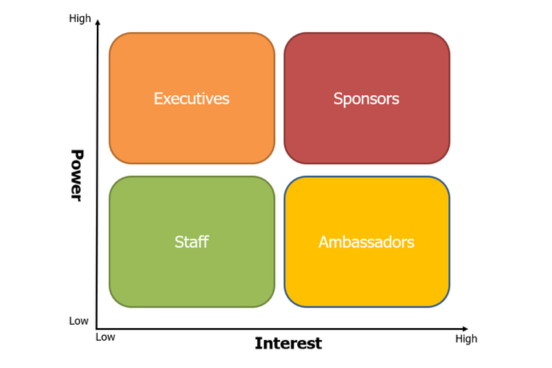
The matrix plots stakeholders on two axes. Power is the ability to influence decisions, block progress, or allocate resources. Interest is how closely a stakeholder is following the work and its progress.
- Staff occupy the low power, low interest quadrant. They are not directly shaping the work and are not closely following it. That does not make them irrelevant. The goal is to bring them along over time and convert them into Ambassadors.
- Ambassadors have low power but high interest. They are closely following the work, they talk about it, and they carry your message into parts of the organization you may not reach directly.
- Sponsors sit at high power and high interest. They are closely following the work, are most impacted by the outcome, and are invested in its success. They are your most critical working relationships.
- Executives have high power but low interest. They hold real authority and are impacted by the outcome, but they are not closely following the work and are not necessarily invested in its success. That makes them easy to overlook and costly to ignore.
These are positional labels based on engagement level, not job titles. An executive who is deeply invested in the outcome belongs in the Sponsor quadrant. A senior leader who holds budget authority but is not tracking the work sits in the Executive quadrant. Power is not always tied to title or organizational authority either. A senior engineer with no formal decision-making role can still block a project. Positions also shift. A stakeholder who was peripheral at the start can move into the Sponsor quadrant when the scope expands to include their area, or when a decision lands that requires their sign-off.
How to Engage Each Group
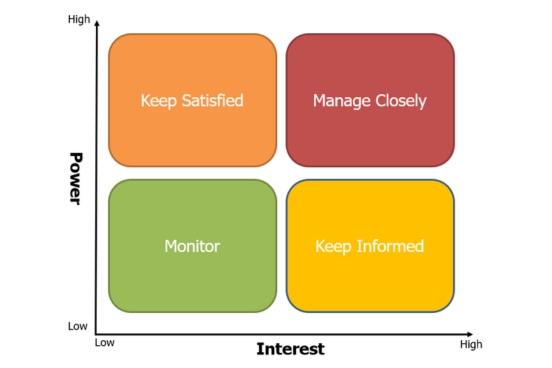
Knowing where a stakeholder sits tells you what kind of relationship to build and how much time to invest.
Monitor Your Staff. Broadcast channels are sufficient here. A newsletter, an intranet post, a quarterly all-hands update. No individualized effort is needed. The goal is to keep them aware and, over time, move them toward Ambassador.
Keep Your Ambassadors Informed. Ambassadors want to know what is happening. They will show up to sprint reviews, read your updates, and reach out with questions. They are already talking about the work. Keep them consistently informed and they will advocate for it accurately.
Manage Your Sponsors Closely. No group has more at stake in the outcome or more invested in seeing the work succeed. Engage them daily, involve them in every critical decision, and treat that access as an asset. They bring organizational knowledge, historical context, and the authority to clear obstacles when you need it.
Keep Your Executives Satisfied. This is where most teams either invest in the wrong way or ignore the group entirely. Unlike Sponsors, Executives are not tracking the work, which means generic updates land as noise or do not land at all. Because they are impacted by the outcome but not invested in the day to day, the message needs to be tailored to what actually affects their area. You need to track them down, understand their specific concerns, and confirm they have no issues. This is not a task you can complete with an email, and it will take more time than any other group. An Executive who discovers a decision was made without their involvement has both the power and the standing to derail the work
You Cannot Treat Every Stakeholder the Same
Stakeholder engagement is not a broadcast. Use the matrix to build a plan for how, when, and how often to engage each group.