Stakeholder alignment sessions often fail not because people disagree, but because the session design assumes everyone will play nice. When you have genuinely conflicting priorities, competing resource constraints, or fundamental differences in strategy, a standard meeting format won’t cut it.
The difference between productive disagreement and unproductive chaos comes down to structure. Without it, even skilled facilitators struggle to keep stakeholder sessions on track.
What works: establish clear ground rules before the discussion starts, ensure balanced participation through structured engagement methods, use visual tracking to keep everyone anchored on the same information, and time-box aggressively to force prioritization.
Establish Ground Rules Before Content Starts
Most sessions jump straight into the agenda. This works when people are aligned. It fails when conflict exists because there’s no shared understanding of how disagreement will be handled or what the session will accomplish.
The biggest mistake is starting a high-stakes discussion without clarifying the decision-making framework. You end up with half the room thinking they’re making the decision while the other half thinks they’re providing input for someone else to decide. People argue passionately under completely different assumptions about what their participation means.
Set explicit ground rules at the start. Get verbal agreement before discussing anything substantive.
Decision-making framework. How will the final decision get made? Consensus means everyone must agree. Majority vote means 51% wins. Consultative means the leader decides after hearing input. Each approach is valid for different situations, but the group needs to know which one applies. Without this clarity, you’re not facilitating a decision process, you’re moderating a complaint session.
If you’re uncertain which decision-making approach fits your situation, frameworks like Roman voting, fist of five, or ranked choice voting can help structure how groups evaluate options and measure support. The decision-making techniques article covers nine specific methods for moving groups from discussion to decision, including when to use consensus versus consultative approaches.
Rules of engagement. What constitutes productive disagreement versus personal attack? What happens when someone dominates the discussion or repeatedly interrupts? Defining these boundaries upfront gives you leverage when things get heated. “We agreed that no one interrupts while someone is presenting their position” carries weight. Making up fairness rules on the fly while someone is steamrolling the conversation does not.
Getting verbal agreement to these rules prevents the most common failure mode: people arguing about process in the middle of arguing about content. When someone violates a ground rule, you can point back to what everyone agreed to rather than defending your facilitation choices.
Ensure Balanced Participation Through Structured Engagement

Verbal brainstorming favors people who think quickly on their feet. In stakeholder sessions with competing priorities, quieter voices, people who process deliberately, and anyone uncomfortable with confrontation will get drowned out in purely verbal discussion.
The result is decisions based on incomplete information. You miss critical perspectives not because people don’t have them, but because the discussion format prevents them from contributing.
Start with silent methods before verbal discussion. Give everyone sticky notes or digital tools and have them write their positions, concerns, or proposed solutions independently before any discussion happens. Set a timer for genuine silence where people think and write without talking.
This levels the playing field. The person who needs processing time gets it. The person uncomfortable speaking up in confrontational environments can contribute their perspective. The person who would normally dominate can’t anchor everyone else’s thinking by stating their position first.
Then move to verbal discussion using the written input as foundation. You’ll surface perspectives that would never emerge in free-flowing debate. You’ll also reduce groupthink because people commit to positions before hearing what everyone else thinks.
Techniques like pairing discussions, the 1-2-4-all method, or speed dating for ideas can further ensure diverse input by creating smaller, safer environments for contribution before bringing ideas to the full group. The alternative facilitation techniques article covers seven specific methods for ensuring everyone contributes, not just the loudest voices.
Use Visual Tracking Throughout the Session
Abstract discussions about strategy or priorities drift into unproductive territory fast. People argue past each other, repeat the same points, or talk in circles because there’s no shared artifact anchoring the conversation. Visual tracking solves this by making positions, conflicts, and decisions visible to everyone simultaneously.
Capture positions as they’re stated. Write each stakeholder’s key points on a whiteboard, shared screen, or wall chart as they present them. This serves two purposes. First, it forces clarity. People who realize their position sounds weak when written down will often refine their thinking on the spot. Second, it creates a record that prevents people from claiming later that their perspective wasn’t heard or was misrepresented.
Map dependencies and conflicts explicitly. Draw out where requirements or priorities actually clash. Most perceived fundamental disagreements are actually sequencing problems or resource allocation conflicts. When you visualize the dependencies, solutions often become obvious. Engineering can’t start until design finishes. Marketing needs the feature before the conference. Legal review takes three weeks. Seeing these constraints mapped together transforms “impossible demands” into a solvable scheduling puzzle.
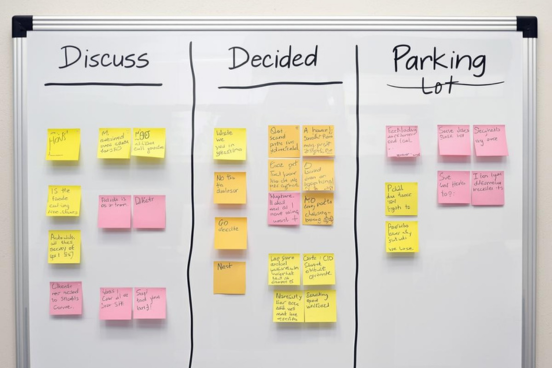
Track decisions and parking lot items where everyone can see them. When something gets decided, write it down in view. When a topic gets deferred, add it to the visible parking lot with a note about who will address it and when. This prevents relitigating closed topics and stops people from repeatedly raising concerns they fear will be forgotten.
The format matters less than visibility. Sticky notes on a wall, a digital whiteboard, a spreadsheet projected on screen. Pick whatever works for your group. The point is creating a shared representation that everyone can see and reference throughout the discussion.
Time-Box Discussions Aggressively

These sessions expand to fill available time. Without structure, dominant personalities talk longer, tangents multiply, and decisions get deferred indefinitely.
Set strict time limits for everything. Each stakeholder gets X minutes to present their position without interruption. Discussion of each topic gets Y minutes before moving to decision or parking lot. The entire session has a hard stop.
Aggressive time-boxing forces prioritization. People focus on their strongest arguments instead of every supporting detail. Discussions stay on critical conflicts instead of exploring every edge case. When someone knows they have 10 minutes instead of unlimited time, they cut to what actually matters.
This feels artificial initially, especially for teams used to open-ended discussion. But constraints create focus. The time pressure prevents the endless circling that characterizes most failed stakeholder sessions. It also limits the damage that dominant personalities can inflict. Someone who would normally consume 40 minutes of a one-hour meeting gets the same 10 minutes as everyone else.
What Actually Makes the Difference
These four techniques work together. Ground rules without time-boxing lead to endless debates. Visual tracking without balanced participation just captures the loudest voices. Each technique addresses a different structural failure mode.
Most stakeholder conflict isn’t irreconcilable. It’s structural. Fix the structure and the conflict becomes manageable.