Part 3 of the Prioritization Series
Previously in this series: Part 1 covered foundational techniques like MoSCoW and Impact/Effort. Part 2 covered scoring frameworks: ICE, RICE, and Weighted Scoring.
The scoring frameworks from Part 2 help you rank work by value, but they have no way to account for what delay costs the business. Sequencing decisions made without that picture leave value on the table.
That’s the gap WSJF and Cost of Delay are designed to fill.
The Missing Dimension: What Does Delay Actually Cost?
Cost of Delay is the economic impact on the business for every unit of time a feature sits undelivered. It covers both the value you fail to capture and the costs you fail to avoid by waiting. Any feature that has value or carries risk has a CoD.
The concept comes from Don Reinertsen’s work on product development flow. As Reinertsen puts it in The Principles of Product Development Flow, CoD is “the golden key that unlocks many doors” because it gives you a common economic unit for comparing work that otherwise seems incomparable.
Dean Leffingwell adapted that work for the Scaled Agile Framework (SAFe), producing WSJF (Weighted Shortest Job First): Cost of Delay divided by job size.
The WSJF Formula
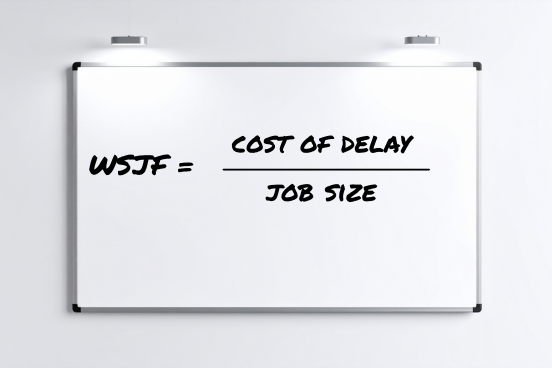
WSJF = Cost of Delay / Job Size
Cost of Delay is broken into three components, each scored on a relative Fibonacci scale (1, 2, 3, 5, 8, 13, 20):
User-Business Value: The direct benefit to users or the business. Revenue impact, strategic importance, customer satisfaction.
Time Criticality: How urgently the cost of delay accumulates. Hard deadlines, competitive windows, and seasonal peaks all create situations where the cost of delay spikes if you miss the window.
Risk Reduction / Opportunity Enablement (RR/OE): The value of reducing future risk or enabling future work. Foundational platform investments, security improvements, architectural changes that unblock multiple future features. These often score low on user-business value but high here because of their downstream effect.
CoD = User-Business Value + Time Criticality + RR/OE
Job Size is the duration or effort required, also scored on the Fibonacci scale. In SAFe this is typically story points or normalized effort. Shorter jobs with equivalent CoD go first because they free up capacity sooner and deliver more value per unit of time.
The Scenario

You’re back at the streaming service. The scoring work from Part 2 compared the Premium Tier against Watch Parties. Now it’s time for quarterly planning across teams. You have four items competing for the next two quarters and need a sequencing decision.
Items on the table:
Privacy Compliance Update – New regional privacy regulations take effect in 90 days. Users must be able to request full data deletion across all devices within that window or the company faces regulatory penalties. Medium user-facing value on its own, but a hard external deadline and meaningful legal risk.
Premium Tier – The $15/month tier from Part 2. Direct revenue increase, proven model, manageable job size.
API Platform – A developer API allowing third-party integrations (smart TV manufacturers, fitness apps, connected devices). No direct user feature. The revenue impact is indirect, but it opens the door to new distribution channels and unblocks three other roadmap items that can’t be built without it.
Personalized Recommendations Upgrade – A significant ML-driven overhaul of the recommendation engine. Broadly considered the highest-value initiative on the roadmap. Strong user-business impact. But it’s a large, complex job.
Applying WSJF
All items are scored relative to each other on the Fibonacci scale.
Scoring the Cost of Delay components:
| Item | User-Business Value | Time Criticality | RR/OE | Cost of Delay |
|---|---|---|---|---|
| Privacy Compliance Update | 3 | 13 | 8 | 24 |
| Premium Tier | 8 | 5 | 3 | 16 |
| API Platform | 2 | 2 | 13 | 17 |
| Personalized Recommendations | 13 | 2 | 3 | 18 |
Rationale:
Privacy Compliance Update: User-business value is modest because users benefit from privacy controls but this isn’t a feature they requested. Time criticality is the highest on the list because the 90-day deadline is fixed and external. Missing it isn’t a missed opportunity, it’s a penalty. RR/OE is high because shipping the compliance capability reduces ongoing legal exposure, preserves the company’s ability to operate in regulated markets, and avoids costlier emergency remediation if the work gets deferred past the deadline.
Premium Tier: High user-business value because it directly increases revenue per subscriber. Moderate time criticality because there’s no hard deadline, but it’s a recurring revenue feature. Every month it isn’t in production is a month of foregone subscription uplift that can’t be recovered. Low RR/OE because it’s a revenue feature, not a platform investment or risk reduction.
API Platform: Low direct user-business value because there’s no user-facing feature. Low time criticality because there’s no external deadline driving urgency. High RR/OE because it enables multiple future revenue streams and unblocks three downstream roadmap items that can’t be built without it. Every quarter the API isn’t built is a quarter those dependent items can’t start.
Personalized Recommendations: Highest user-business value because it affects every subscriber’s experience. Low time criticality because there’s no deadline or competitive event that makes the rate of foregone value spike. Low RR/OE because it’s a direct user feature, not an enabler.
Calculating WSJF:
| Item | Cost of Delay | Job Size | WSJF Score | Rank |
|---|---|---|---|---|
| Privacy Compliance Update | 24 | 2 | 12.0 | 1st |
| Premium Tier | 16 | 2 | 8.0 | 2nd |
| API Platform | 17 | 5 | 3.4 | 3rd |
| Personalized Recommendations | 18 | 8 | 2.25 | 4th |
WSJF Example

The ranking has two results that a straight value-based framework would miss.
First, Personalized Recommendations ranks last despite having the highest user-business value on the list. Its WSJF score is the lowest because the job requires eight units of effort. The other three items have a better CoD-to-job-size ratio, so they go first.
Second, the API Platform ranks ahead of Personalized Recommendations despite a lower CoD score. Personalized Recommendations carries a CoD of 18 but requires eight units of effort. The API Platform has a CoD of 17 and requires five. Building the API first also means three other roadmap items become available in the next planning cycle. That downstream value is real, and ignoring it in prioritization leads to architectural work getting perpetually deprioritized in favor of user-facing features.
The compliance item topping the list won’t surprise anyone who already knew about the deadline. But that’s exactly the point: WSJF confirms what common sense would tell you about time-critical work, while also surfacing the less obvious sequencing insights like the API Platform case.
The instinct in most teams is to tackle the biggest, most important initiative first. WSJF pushes back on that by making job size part of the sequencing calculus, making the tradeoff between large high-value work and smaller high-CoD items visible.
Limitations and When to Use WSJF
WSJF has real limitations worth understanding:
Scoring is still relative and subjective. The Fibonacci scale creates structure, but the underlying scores reflect judgment. Teams new to WSJF will have debates that aren’t really about the formula.
CoD components can be gamed. Every product manager learns quickly that scoring RR/OE high will move almost anything up the list. The discipline is in the conversation the scoring prompts, not in the math itself.
Job size needs honest estimates. The formula is only as useful as your effort estimates. Consistently underestimating job size inflates WSJF scores for large items. Teams with poor estimation track records will get misleading rankings.
WSJF doesn’t account for dependencies. An item with a WSJF score of 12 might depend on an item with a WSJF score of 2. The formula won’t tell you that. Dependency mapping has to happen alongside WSJF scoring.
Use WSJF at the portfolio or program level, where you’re sequencing work across teams over multiple planning increments and where items have genuinely different urgency profiles. It’s particularly effective at getting compliance, architectural, and risk-reduction work the prioritization attention it deserves against a backlog of compelling user features. For day-to-day sprint planning or small feature decisions within a stable product area, the simpler frameworks from Parts 1 and 2 are sufficient.
Next in this series: We’ll cover financial prioritization methods including ROI, Net Present Value (NPV), and Internal Rate of Return (IRR) for investment decisions that require executive approval and capital allocation.
If your team needs hands-on practice applying WSJF or any of the frameworks in this series, the Prioritization Workshop covers these techniques in the context of your actual product decisions. For broader product development capability, the Building Innovative Products Workshop applies prioritization within the full product development lifecycle.