Product Team Focus: Input vs Output vs Outcome vs Impact

Product teams often struggle with measuring what truly matters. Are we shipping enough features? Are users engaging? Are we moving the business needle? The confusion stems from conflating four distinct concepts: input, output, outcome, and impact. Teams frequently focus on shipping features rather than changing user behavior, leading to products that technically work but don't create…

Comments Off on Product Team Focus: Input vs Output vs Outcome vs Impact

Project Management vs Product Management: 10 Key Differences For Smart Teams Making the Switch

Learn why teams are switching from project management to product management. Discover key differences, benefits, and practical steps for software development success. Ever delivered a project perfectly on time and on budget, only to watch it sit unused by customers? This disconnect between execution success and business impact reveals a fundamental gap in how traditional project…

Comments Off on Project Management vs Product Management: 10 Key Differences For Smart Teams Making the Switch

Product Model Principles: A Brief Guide

The product model, as developed by Marty Cagan and the team at Silicon Valley Product Group, represents how the world's most successful technology companies actually build products. These principles guide how companies like Google, Apple, Netflix, and Amazon consistently deliver exceptional value to their users. Here's what separates companies that create products customers love from those…

Comments Off on Product Model Principles: A Brief Guide

How to Handle Scope Creep in Scrum: A Guide for Agile Teams

Picture this: You're three weeks into a sprint when your stakeholder drops by with "just one small addition" to the feature you're building. Sound familiar? Welcome to what traditional project managers call scope creep. But here's the thing about scope creep in Scrum: it doesn't exist. Not because requirements don't change (they absolutely do), but because…

Comments Off on How to Handle Scope Creep in Scrum: A Guide for Agile Teams
Read more about the article Product Discovery and Validation: 10 Proven Techniques for Better Products
Product Management Training and Coaching

Product Discovery and Validation: 10 Proven Techniques for Better Products

Building products without validating them first is like cooking without tasting. You might get lucky, but more often than not, you'll end up with something nobody wants to consume. Product discovery isn't just a nice-to-have in your development process. It's the foundation that determines whether your product will solve real problems or just add to the…

Comments Off on Product Discovery and Validation: 10 Proven Techniques for Better Products

How to Use Design Sprints to Validate Product/Market Fit

Design Sprints is a discovery technique created by Jake Knapp and popularized in his book Sprint - How to solve big problems and test new ideas in just 5 days, based on techniques he used helping teams while working at Google Ventures. Design sprints are not a part of Scrum and the Design Sprint concept differs…

Comments Off on How to Use Design Sprints to Validate Product/Market Fit

Creating Powerful Sprint Goals: A Practical Guide for Agile Teams

How to Write an Effective Sprint Goal? Crafting effective Sprint Goals is essential for Scrum team success. A well-written Sprint Goal provides focus, direction, and purpose for your team's work during each Sprint. This guide will show you exactly how to create Sprint Goals that drive meaningful outcomes. What Makes a Sprint Goal Effective? Great Sprint…

Comments Off on Creating Powerful Sprint Goals: A Practical Guide for Agile Teams

7 Risks in Waterfall Development

What is Waterfall Development? When most of us think about traditional project management, we're picturing waterfall development. It's that step-by-step approach where you finish one phase completely before moving to the next one. Winston Royce wrote about it back in 1970, and teams have been using it ever since. But here's the thing: as markets move…

Comments Off on 7 Risks in Waterfall Development

The Definition of Done vs. the Acceptance Criteria

The Definition of Done often gets confused with the Acceptance Criteria. Acceptance Criteria Acceptance Criteria is specific to a user story and it will differ from one user story to the next as it’s tied to a particular functionality or feature. The acceptance criteria further clarifies the feature by proving context and intent. It helps manage…

Comments Off on The Definition of Done vs. the Acceptance Criteria

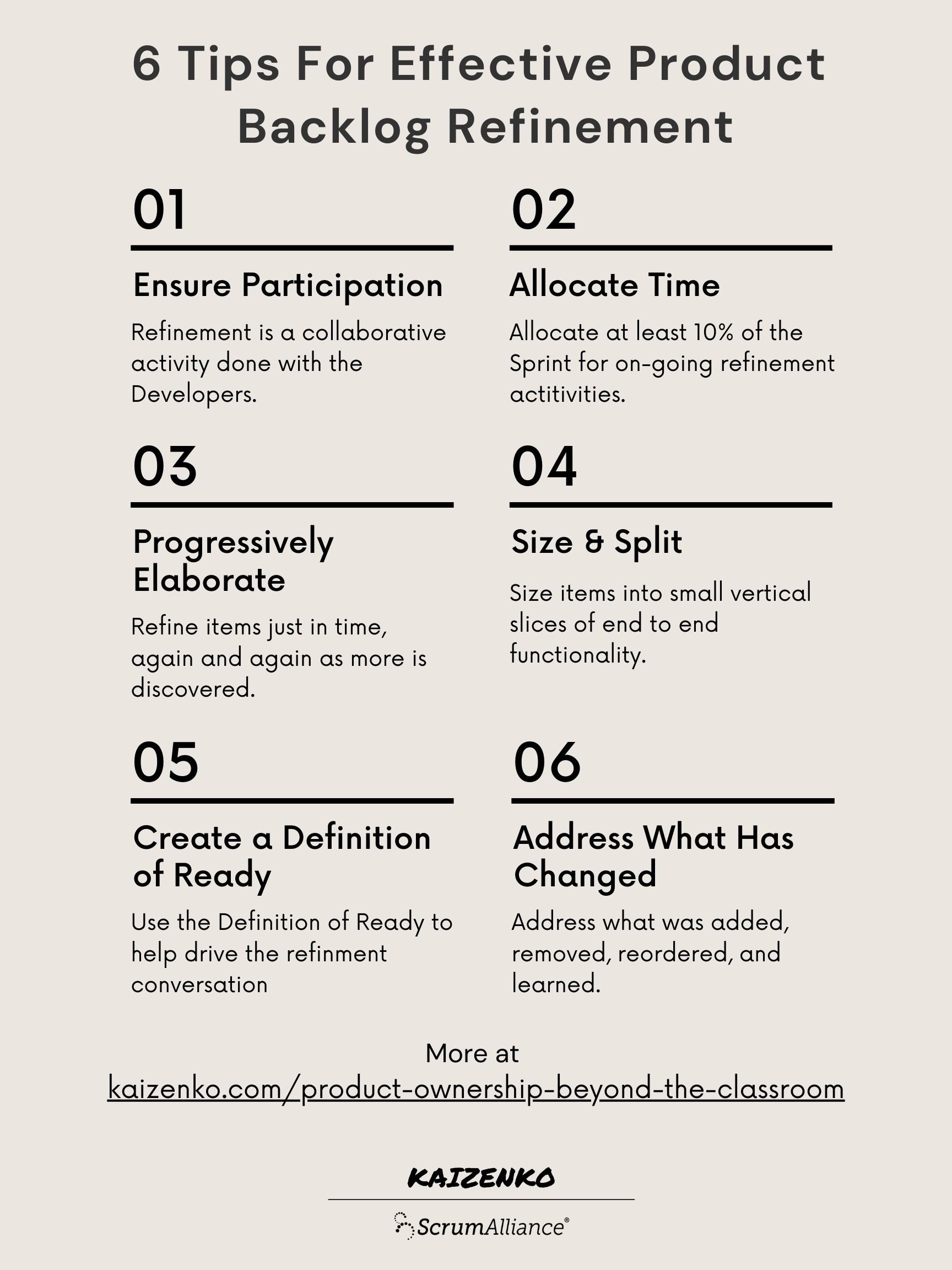
6 Tips for Effective Product Backlog Refinement

The Scrum Guide defines Product Backlog Refinement as the act of breaking down and further defining Product Backlog items into smaller more precise items. This is an ongoing activity to add details, such as a description, order, and size. Product Backlog Refinement is a key activity in Scrum that is often overlooked. If a team finds…

Comments Off on 6 Tips for Effective Product Backlog Refinement

Top 13 Patterns to Split a User Story

Many teams struggle with breaking up or splitting a user story into smaller ones. Here are the top 13 patterns to split a user story that you can use when clarifying user stories with the team during product backlog refinement. Start by asking: 1. By Business or User Perspective Can a business stakeholder understand the user…

Comments Off on Top 13 Patterns to Split a User Story

9 User Story Smells and Anti-patterns

1. Thinking that everything is a user story Many mistakenly believe that if you are Agile or using Scrum, then you must use user stories and no other format is acceptable. User stories are not required in Scrum. Product Backlog Items can take any format. User stories are a recommended technique due to some benefits over…

Comments Off on 9 User Story Smells and Anti-patterns

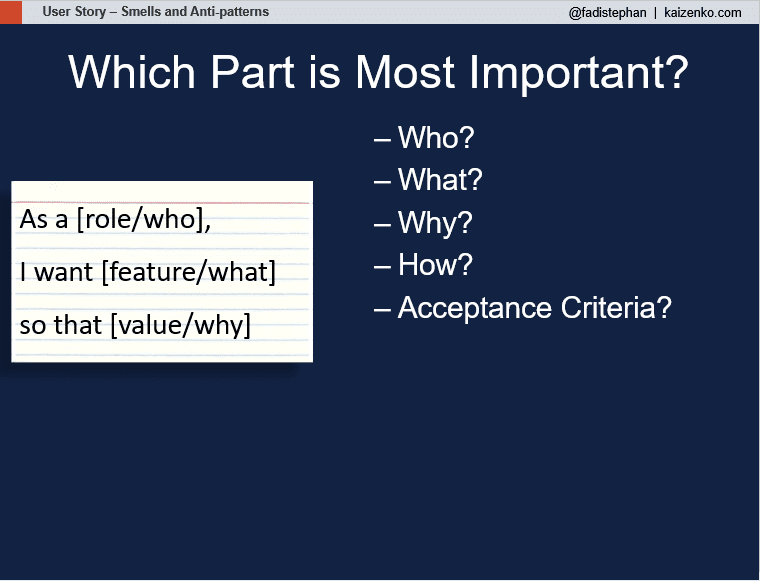
What’s the Most Important Part of a User Story?

Looking at the user story template, which part of the user story is the most important? Is it the Who, What, Why, How, or Acceptance Criteria? The How Let’s first look at the How – It’s important to note that the user story does not contain details about the How. Generally, the how are technical tasks…

Comments Off on What’s the Most Important Part of a User Story?

Top 5 Techniques for Splitting a User Story

When splitting user stories, we should always split them vertically as if we are slicing a piece of cake. The whole cake is a cake and each vertical slice is a piece of cake with all it’s layers. A horizontal slice might just have the icing, or maybe just the filling, or just the crust and…

Comments Off on Top 5 Techniques for Splitting a User Story

What’s the Right Size for a User Story

Product Backlog Items (PBIs) or user stories should be small. Small stories provide focus for the team and gives members the flexibility to adjust and adapt to changes. The larger the story, the higher the risk of team members getting lost in the details and creating bottlenecks as members are busy and unavailable to collaborate and…

1 Comment