Anyone who has led organizational change has seen a predictable pattern. The change is introduced. Resistance follows. Performance drops. Teams struggle through uncertainty before things stabilize at a new normal, if they get there at all.
The initiative is sound. The case for change is clear. And yet people resist and what looked straightforward on paper becomes complicated in practice. The Satir Change Model describes this pattern. The question is why it happens and what leaders can do about it.

What the SCARF Model Is
In 2008, David Rock published a paper in the NeuroLeadership Journal introducing the SCARF model, a framework grounded in social neuroscience research. The central finding is that social interactions draw on the same brain networks used for primary survival needs. The brain responds to a social threat the same way it responds to physical danger.
That response is what Rock calls the approach-avoid mechanism. When the brain perceives a threat, it moves to avoid it. When it perceives a reward, it moves toward it. The response is automatic, happening unconsciously.
SCARF identifies five domains that trigger this response: Status, Certainty, Autonomy, Relatedness, and Fairness. Organizational change tends to put pressure across multiple domains at once.
The Five SCARF Domains During Organizational Change
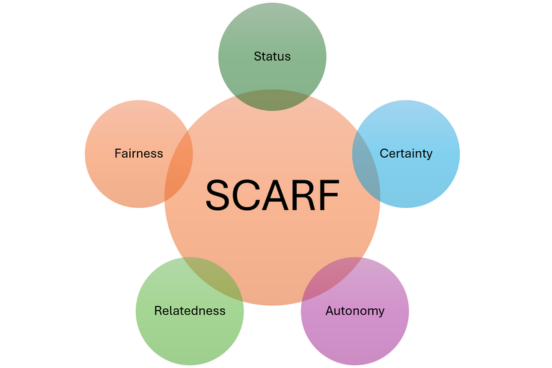
Status
Status is about relative importance. Where do I stand in relation to others, and will that change?
The perception of a potential reduction in status is enough to activate a threat response. The key word is potential. People do not need confirmation that their standing has changed. During organizational change, people begin questioning whether their expertise, role, or experience will carry the same value in the new structure. That questioning happens before the facts are in.
Certainty
The brain is a pattern-recognition system. It works by predicting what comes next, and it does this continuously. When those predictions are disrupted, the brain generates what Rock describes as an error response, pulling attention away from work and toward the source of uncertainty. Larger uncertainties, like not knowing whether your role is secure or what the new structure means for your team, are harder to resolve and demand more of the brain’s attention as a result.
Autonomy
Autonomy is the perception of control over one’s environment. When people have no influence over what is happening to them, the threat response follows.
Organizational change threatens autonomy in two ways. The change itself can reduce the control people have over how they work, who they work with, and what decisions they make. The process compounds it. Change is typically announced rather than co-developed. The decision is made, the communication goes out, and people are expected to implement. Even routine announcements that leave no room for input can trigger the response.
Relatedness
Relatedness is the sense of safety with others. Rock’s research shows that meeting someone unknown tends to generate an automatic threat response. Trust in established teams is built over time, and it carries real weight in how work gets done.
Reorganizations disrupt that. When familiar working relationships break up, or when people find themselves on new teams with unfamiliar colleagues, the trust that existed in the previous structure does not transfer. It has to be rebuilt.
Fairness
Fairness is the perception of fair exchanges between people. Rock’s paper shows that unfair exchanges generate a strong threat response. When the rationale for a change is unclear, or when the burden of the change appears to fall unevenly, people focus on the inequity. The change itself becomes secondary to the perception of unfairness.
Applying SCARF During Organizational Change

Each domain points to a specific type of action.
- Status: Acknowledge expertise and past contributions explicitly. Give people visible opportunities to demonstrate competence in the new context. Status threats can diminish when people can see that what they have built still has value.
- Certainty: Communicate early and often, even when the full picture is not yet available. Silence does not reduce the threat response. It compounds it. When people receive no information, they fill the gap themselves, and the conclusions they reach are rarely more reassuring than the facts would have been. Smaller, clearer steps can reduce the uncertainty people are navigating.
- Autonomy: People respond better when they have some control over how change affects their work. Involve them in decisions about how they will work within it, even when the change itself is not up for debate.
- Relatedness: Reorganizations disrupt trust built over time. Protect team structures where you can. Where you cannot, build new connections early.
- Fairness: Be transparent about why the change is happening and clear about who is affected. When either is missing, people will question whether the change is fair.
Kotter’s 8-step model gives leaders a process for managing organizational change. SCARF gives leaders a way to understand what people are experiencing while that process unfolds. Used together, they address both dimensions: what the organization needs to do, and what the people inside it are going through.