How AI Replicates Human Intelligence: Sense, Understand, Create

Human intelligence does three fundamental things. It perceives the world through the senses. It makes meaning from what it perceives. And it produces something in response, whether a decision, a piece of work, or a new idea. AI is advancing through these same three capabilities. Understanding where AI stands in each one is a more useful…

Comments Off on How AI Replicates Human Intelligence: Sense, Understand, Create

What the SCARF Model Reveals About Human Reaction to Change

Anyone who has led organizational change has seen a predictable pattern. The change is introduced. Resistance follows. Performance drops. Teams struggle through uncertainty before things stabilize at a new normal, if they get there at all. The initiative is sound. The case for change is clear. And yet people resist and what looked straightforward on paper…

Comments Off on What the SCARF Model Reveals About Human Reaction to Change

Supervised Learning: How Machines Learn from Examples

Supervised learning is the branch of machine learning behind spam filters, fraud detection systems, medical imaging tools, and large language models like ChatGPT. Understanding how it works, and where it reaches its limits, matters for anyone making decisions about building or buying AI-powered products. What Supervised Learning Actually Is Supervised learning is a method where a…

Comments Off on Supervised Learning: How Machines Learn from Examples

Machine Learning: The Engine Behind Modern AI

Product leaders today operate in a field shaped by AI. This is the first in a series of posts that maps that field, starting with the foundational concepts: what AI is, how machine learning works, and what distinguishes the main approaches in use today. AI vs. Machine Learning Artificial intelligence refers to systems that can perform…

Comments Off on Machine Learning: The Engine Behind Modern AI

OpenAI’s Five Levels of AI: A Roadmap From Chatbots to AGI

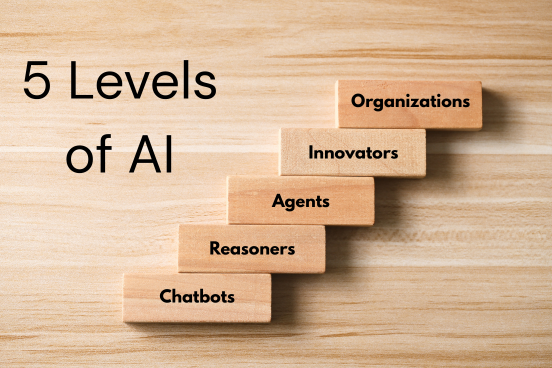
OpenAI has mapped out five levels of AI capability on the path to Artificial General Intelligence, or AGI. It has become a useful way to understand where AI is today, what comes next, and how far the progression extends. The five levels are: Chatbots, Reasoners, Agents, Innovators, and Organizations. Each represents a meaningful increase in what…

Comments Off on OpenAI’s Five Levels of AI: A Roadmap From Chatbots to AGI

Three Levels of AI Capability Every Leader Should Understand

The AI powering your credit card fraud detection, the AI drafting your team's content, and the AI researchers are working toward next represent fundamentally different levels of capability. Where a given system sits on that progression changes how you deploy it, what you invest in, and what you should realistically expect from it. Narrow AI: The…

Comments Off on Three Levels of AI Capability Every Leader Should Understand

AI Is Not Just Another Tech Trend. It’s a Paradigm Shift.

Every generation or so, a technology comes along that doesn't just improve what exists. It rewrites the rules entirely. Economists Timothy Bresnahan and Manuel Trajtenberg coined the term General Purpose Technology, or GPT, for this kind of technology. These technologies share three defining characteristics: they spread across most sectors of the economy, they improve over time,…

Comments Off on AI Is Not Just Another Tech Trend. It’s a Paradigm Shift.

Netflix Case Study on Business Agility

In 2000, Blockbuster generated nearly $800 million from late fees. That same year, Netflix eliminated late fees entirely, walking away from revenue its competitor couldn't live without. One company adapted to what customers wanted. The other protected what its business model required. Today, Netflix's market cap exceeds $325 billion (as of February 2026). Blockbuster no longer…

Comments Off on Netflix Case Study on Business Agility

Twenty-Five Years After Agile: The Same Competitive Dynamics, Only Faster

Twenty-five years ago, seventeen software developers met at a ski resort in Utah and published a manifesto that changed how products get built. They challenged the dominant model of the time: long planning cycles, extensive documentation, rigid specifications, and change control boards. The Manifesto for Agile Software Development argued for something different: short iterations, customer collaboration,…

Comments Off on Twenty-Five Years After Agile: The Same Competitive Dynamics, Only Faster

How The AI Era is Transforming Business: Three Metrics That Tell the Story

Three metrics reveal how the fundamentals of building and scaling companies has changed in the AI era: how quickly products reach mass adoption, how fast businesses generate significant revenue, and how much value teams can create relative to their size. The differences aren't marginal. The data shows transformative shifts in business performance. 1. Rapid User Acquisition…

Comments Off on How The AI Era is Transforming Business: Three Metrics That Tell the Story

Why Kotter’s Change Management Model Matters for Product Organizations and Teams

Most organizational change efforts fail. Not because the ideas are bad, but because leaders underestimate how difficult it is to actually change how people work. John Kotter's 8-Step Change Management Model addresses this problem directly. It's a framework that acknowledges a basic truth: lasting change requires more than an announcement and a new process document. If…

Comments Off on Why Kotter’s Change Management Model Matters for Product Organizations and Teams

How to Measure Agile Maturity: Start With Business Goals, Not Generic Assessment Frameworks

Most agile maturity assessments fail before they begin. Teams fill out questionnaires about daily standups, sprint planning, and retrospectives. They score themselves on how well they follow Scrum practices. They get a maturity level, create improvement plans, and wonder why nothing meaningful changes despite following recommended practices. The root problem is not the assessment itself. The…

Comments Off on How to Measure Agile Maturity: Start With Business Goals, Not Generic Assessment Frameworks

The Cynefin Framework: A Sense-Making Tool for Product Leaders

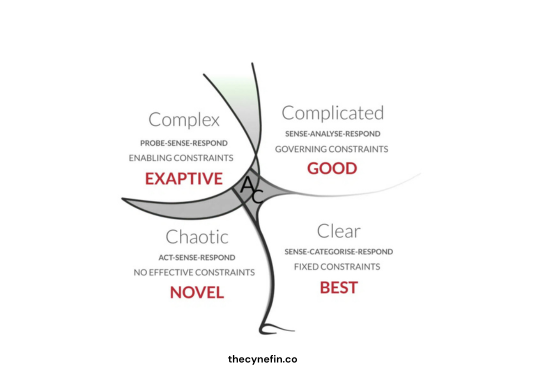
You've seen it happen. A team that nails predictable work completely falls apart when facing something unprecedented. Or a leader who excels at crisis management tries to apply that same urgency to stable operations and creates chaos. The problem isn't capability. It's context blindness. Most leaders treat all problems as if they require the same approach.…

Comments Off on The Cynefin Framework: A Sense-Making Tool for Product Leaders

How to Build Organizational AI Capabilities: From Individual Tools to Organizational Success

Your teams are using AI tools for individual tasks, but your organization hasn't developed coordinated AI capabilities. A fragmented AI implementation limits the business value you get from AI investments, and individual productivity gains don't translate into team-level improvements or organizational competitive advantages. Organizations that struggle with this type of AI coordination challenge often face similar…

Comments Off on How to Build Organizational AI Capabilities: From Individual Tools to Organizational Success

The Competing Values Framework: Understanding Organizational Culture for Strategic Decision-Making

When organizations get stuck, change initiatives stall, and agile transformations fail to gain traction, the underlying issue often isn't strategy or resources. It's culture. The Competing Values Framework gives you a systematic way to understand the cultural forces at play in your organization and make more informed decisions about where to focus your energy. What Is…

Comments Off on The Competing Values Framework: Understanding Organizational Culture for Strategic Decision-Making